Cryptocurrency was created to remove reliance on centralized institutions, but with that freedom comes responsibility. When users hold their own assets, they also become their own bank, security team, and recovery service. Mistakes cannot be reversed, passwords cannot be reset, and lost access often means lost funds.
This reality has driven the rise of hardware wallets, and among them, Trezor remains one of the most respected names. However, the hardware device alone is only part of the equation. To interact safely with blockchain networks, users need reliable software that does not weaken the protection provided by the device.
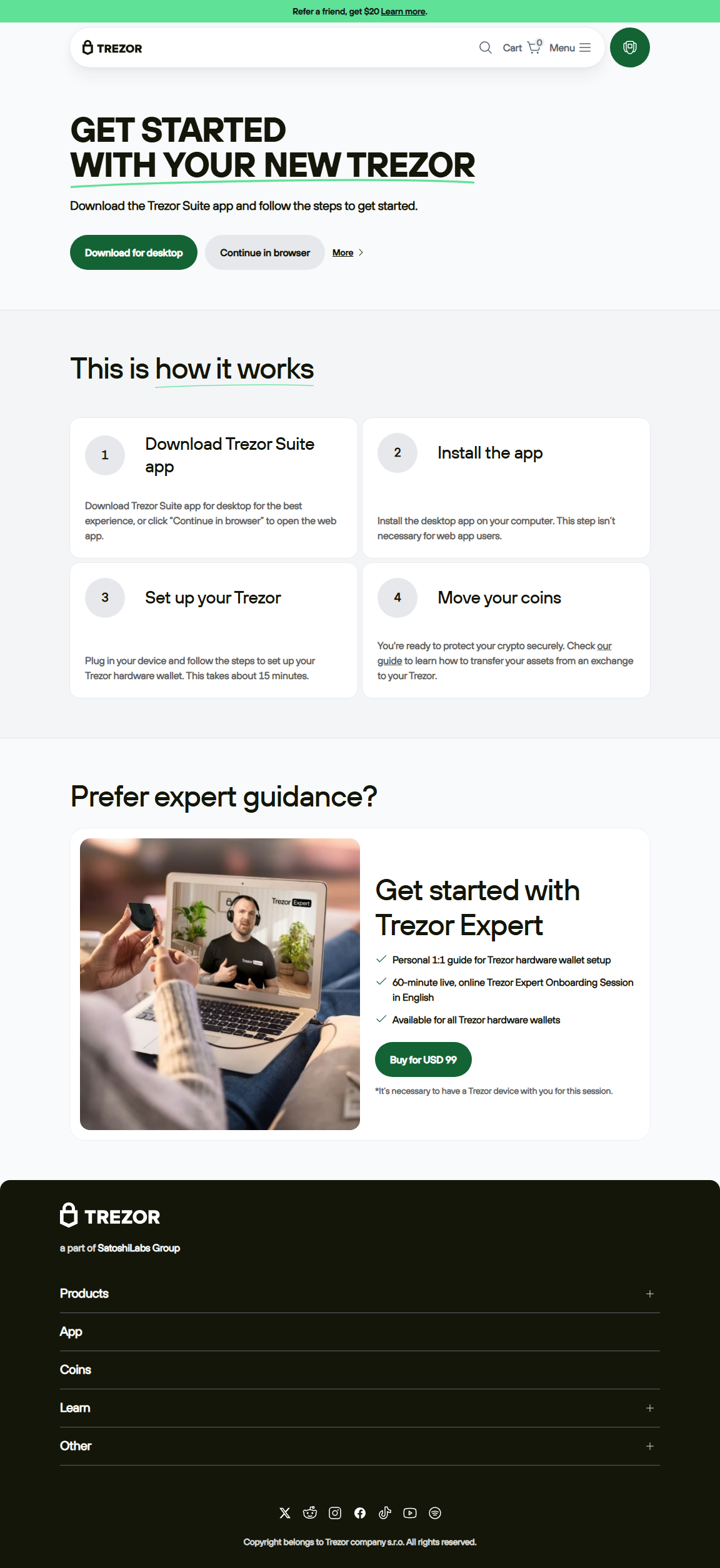
Trezor Suite is that software. It is the official, purpose-built environment that allows users to manage cryptocurrencies securely while keeping private keys permanently offline. Rather than functioning as a typical wallet app, Trezor Suite acts as a controlled gateway between the user and decentralized networks.
This article explains what Trezor Suite is, how it operates, and why it plays a crucial role in secure crypto ownership.
Trezor Suite is the official management software for Trezor hardware wallets. It enables users to:
What makes Trezor Suite fundamentally different from most wallet software is its trust model. It never holds private keys, never generates seed phrases, and never signs transactions. All sensitive operations occur inside the hardware wallet.
Trezor Suite prepares information; the device makes decisions.
Many crypto losses do not happen because blockchains are hacked, but because users interact with unsafe software. Fake wallet apps, browser extensions, and phishing tools often trick users into exposing recovery phrases or approving malicious transactions.
Trezor Suite reduces these risks by:
Using unofficial software alongside a hardware wallet weakens the entire security model.
Trezor Suite is designed around separation of duties.
Because of this separation, even a compromised computer cannot steal funds without access to the physical device.
If a feature introduces unnecessary risk, it is avoided—even if it reduces speed or automation.
There are no user accounts, no cloud logins, and no centralized recovery systems.
The open-source nature of Trezor Suite allows anyone to review how it works.
The interface encourages safe behavior and warns users during critical actions.
Trezor Suite is available for:
This version is recommended for most users, especially those managing significant value.
A web version exists for users who need quick access. While convenient, it maintains the same security rules—no transaction proceeds without device confirmation.
Trezor Suite works with all current Trezor hardware wallets, including:
Security principles remain identical across models, with differences mainly in interface and advanced recovery options.
When users open Trezor Suite for the first time, the experience is deliberately structured.
Rather than assuming knowledge, the software:
This onboarding reduces early mistakes, which are among the most common causes of crypto loss.
When creating a new wallet, the most important event is the generation of the recovery seed.
Key facts:
Users must write the seed down manually and store it securely. Anyone who gains access to this seed controls the funds.
There is no workaround and no recovery service.
If a device is lost, damaged, or reset, Trezor Suite allows users to restore access using the recovery seed.
During recovery:
Funds are not stored on the device—they remain on the blockchain. The seed simply restores access.
Trezor Suite presents balances and transaction history in a clean, readable format. Users can quickly see:
The focus is clarity, not speculation or price hype.
Sending funds follows a strict, multi-step flow:
If the details on the computer and device do not match, the transaction should be rejected immediately.
To receive funds:
This prevents malware from substituting addresses during copying or pasting.
Trezor Suite allows users to create multiple accounts per asset. This helps with:
All accounts are protected by the same recovery seed but operate independently.
Trezor Suite supports a broad range of cryptocurrencies, including:
Support depends on firmware version and device capabilities, which can be updated through the software.
Privacy is often underestimated in crypto, yet transaction data is public by default. Trezor Suite provides tools to reduce exposure.
Users can route traffic through Tor, hiding IP addresses from blockchain servers.
Advanced Bitcoin users can manually choose transaction inputs, improving privacy and fee efficiency.
Labels and notes remain on the user’s device rather than being uploaded to centralized servers.
Firmware controls how the hardware wallet behaves. Installing unverified firmware is extremely dangerous.
Trezor Suite:
Updates may introduce security improvements, new features, or expanded asset support.
Most users rely on written or metal backups stored in secure locations.
Some devices support splitting the recovery seed into multiple shares. This allows recovery using a subset of shares rather than a single backup.
Benefits include:
Often resolved by changing cables, ports, or restarting the application.
Usually related to network congestion or low fees rather than software errors.
The device can be reset and restored using the recovery seed.
Trezor Suite provides clear guidance for each scenario.
Most losses happen due to social engineering, not technical failure.
While Trezor devices can connect to third-party wallets, Trezor Suite offers:
For long-term holders, fewer moving parts often mean fewer risks.
Trezor Suite is suitable for:
Its design avoids unnecessary complexity while preserving strong protection.
Trezor continues to improve Trezor Suite through:
This ensures that the software remains relevant as the ecosystem evolves.
Trezor Suite is not designed to impress with flashy features—it is designed to protect. By enforcing clear boundaries between software and private keys, it allows users to interact with decentralized networks while minimizing risk.
In a financial system where responsibility cannot be outsourced, Trezor Suite provides structure, clarity, and confidence. For anyone serious about owning cryptocurrency securely over the long term, it remains one of the most dependable tools available.